
Senin, 29 Oktober 2007

Thomas Hull, "Project Origami: Activities for Exploring Mathematics"
Thomas Hull, "Project Origami: Activities for Exploring Mathematics" A K Peters, Ltd ISBN / ASIN: 1568812582 2006 272 pages PDF 17.2MB
When it comes to mathematics, paper isn't just for pen and pencil any more! Origami, the art and science of paper folding, can be used to explain concepts and solve problems in mathematics-and not just in the field of geometry. The origami activities collected here also relate to topics in calculus, abstract algebra, discrete mathematics, topology, and more. Using origami, learn about: * Solving Cubic Equations * Bucky Balls and PHiZZ units * Matrix models for folds * Gaussian Curvature and much more!

When it comes to mathematics, paper isn't just for pen and pencil any more! Origami, the art and science of paper folding, can be used to explain concepts and solve problems in mathematics-and not just in the field of geometry. The origami activities collected here also relate to topics in calculus, abstract algebra, discrete mathematics, topology, and more. Using origami, learn about: * Solving Cubic Equations * Bucky Balls and PHiZZ units * Matrix models for folds * Gaussian Curvature and much more!

300 Diagram Origami
It's a very good collection of books and every step is diagrammed. The file is a .pdf and about 22 meg long. Heres a screenshot I took


Minggu, 21 Oktober 2007
Bugs And Birds in Origami
Book Description Easy-to-follow guide gives step-by-step instructions for creating more than 25 origami birds and bugs, including a pair of ducks and geese, a cardinal, an anhinga, an open-mouthed pelican, a woodpecker, a turkey, and a vulture with outstretched wings. The bugs include several beetles, a wasp, a spider, and a butterfly.
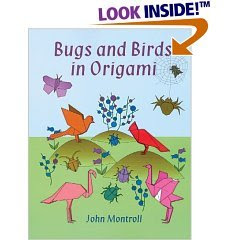 if interest..email me... i will give you a copy this e-book
 if interest..email me... i will give you a copy this e-book

Are You Ready Learn Origami?
 This e-book begins with simple models and works up to more intricate ones. Each is folded from an uncut square. The book also contains a brief explanation of the symbols used to indicate various folds, and several pages explaining folds and "bases" considered basic. (Many models share the same initial folds; the result of some common beginning folds is called a base, e.g. "bird base", "frog base".) Here are the critters you learn to fold. ("Steps" is really the number of illustrations, not the total number of folds, which would have been more tedious to count. It's still a reasonable indicator of complexity, though.) Angelfish (8 steps) Seal (18 steps) Walrus (21 steps) Starfish (29 steps) Crane (37 steps) ... not traditional. Swan (21 steps) Eagle (14 steps) Owl (23 steps) Tyrannosaurus (18 steps) Brontosaurus (16 steps) Snake (24 steps) Turtle (39 steps) Frog (49 steps) also Frog With Toes (+ 24 steps), for the tree frog look. Bear (39 steps) Kangaroo (40 steps) Giraffe (41 steps) Fox (56 steps) Elephant (55 steps) Antelope (51 steps) Spider (86 steps) Crab (86 steps) Lobster (114 steps) Ornament (21 steps) Star (19 steps) .
U want it??... i will give copy if ur email me.. because its just for seriouse person.


Langganan:
Postingan (Atom)